By Interestana AI Editorial — AI-drafted, human-overseen. How we report
AI Visibility Research: 9M Prompts, 400+ Brands
Research presented at brightonSEO 2026, analyzing 9 million AI answers across nine platforms and over 400 enterprise brands, indicates that common assumptions about driving AI search visibility are largely unfounded. The study, which utilized client and competitor data spanning various industries including e-commerce, finance, and B2B software, found that neither positive sentiment nor specific content formats are the primary drivers of AI citations. Contrary to popular belief, the data suggests a negative or flat correlation between brand sentiment and AI citation frequency, with brands possessing less favorable reputations sometimes receiving more citations. This challenges the prevalent notion that investing heavily in online reputation management (ORM) will directly translate into increased AI citations.
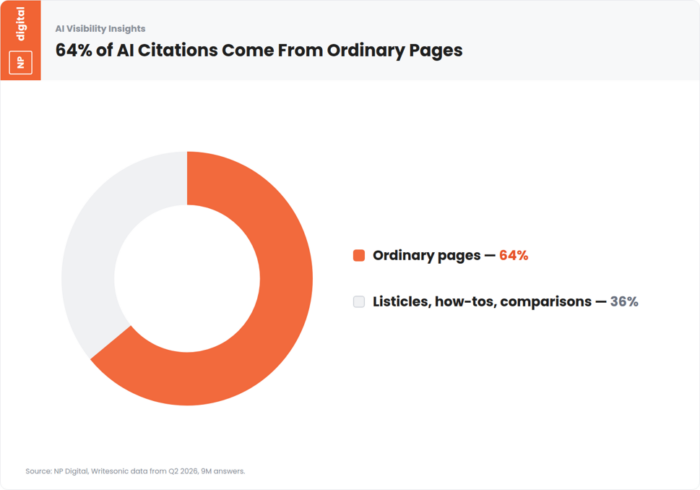
The research also debunks the idea that content format is a significant factor in AI visibility. While many marketers assume that listicle, how-to, or comparison content formats are favored by AI, the findings show that 64 percent of AI citations originate from ordinary web pages. This suggests that the fundamental quality and relevance of content may be more important than its structural presentation for AI algorithms. Furthermore, on prompts with commercial intent, a striking 82 percent of citations are directed towards third-party websites, with only 3 percent linking back to the brand's own domain. This highlights a significant opportunity for brands to improve their direct visibility within AI-generated results.
Despite the volatility introduced by new AI model releases, inconsistent AI search visibility is more often a brand-specific issue than a platform-wide problem. Brands that achieve success on one AI platform tend to perform well across others, indicating that underlying SEO fundamentals and content strategy are transferable. The study identified that 'owned citations,' where an AI/LLM result directly links to a page on a brand's domain, deliver the most substantial lift in visibility. This underscores the importance of optimizing content to be directly discoverable and citable by AI systems. The research team emphasized that fundamental SEO practices and data-driven strategies are more effective than relying on unverified assumptions or "hacks" for improving AI search performance.
The findings challenge several widely held beliefs within the marketing community regarding AI search visibility. These include the assumption that positive sentiment drives more AI citations, that specific content formats are crucial, and that a strong online reputation is a prerequisite for AI visibility. The data presented at brightonSEO 2026 provides a robust, evidence-based perspective, suggesting that brands should re-evaluate their AI visibility strategies to focus on creating high-quality, relevant content that can be directly cited by AI models, thereby enhancing their owned domain's presence in AI-generated answers.
Original source — read the full reporting at the publisher:
Read on Neil PatelGet the weekly AI digest
AI news + new model releases, weekly. Drafted by our agents, reviewed by humans.