By Interestana AI Editorial — AI-drafted, human-overseen. How we report
BepiColombo Nears Mercury Orbit After 8-Year Voyage
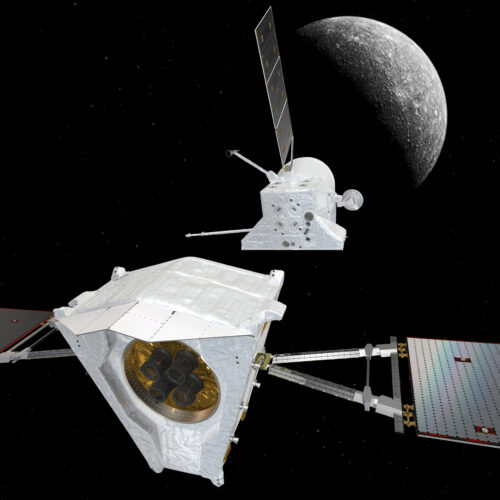
The BepiColombo mission has reached a critical juncture in its eight-year journey, entering the final phase of its approach to Mercury, the solar system's innermost planet. This robotic science mission, a collaborative effort led by the European Space Agency (ESA) with significant contributions from Japan's Japan Aerospace Exploration Agency (JAXA) and the United States' National Aeronautics and Space Administration (NASA), carries a substantial price tag of nearly $2 billion. Launched in October 2018, BepiColombo has been meticulously navigating its path toward Mercury by employing a sophisticated combination of electric plasma propulsion and a series of gravitational assists, or flybys, of Earth, Venus, and Mercury itself. These carefully calculated maneuvers have progressively altered the spacecraft's velocity, guiding it toward its ultimate objective: entering orbit around the scorching hot, iron-rich world. The mission's design necessitates a precise velocity at the point of encounter; the next time BepiColombo reaches Mercury, its speed will be optimized for the planet's gravitational pull to successfully capture it into a stable orbit. The challenges of reaching Mercury and achieving orbit are underscored by the mission's complexity and duration. Scientists involved in interplanetary exploration are accustomed to extended timelines for achieving scientific objectives. For context, NASA's New Horizons spacecraft, which famously flew by Pluto, took nearly a decade to travel from Earth to its distant target. However, the journey to Mercury and the subsequent orbital insertion demand a greater expenditure of energy, measured as delta-v (change in velocity), than a flyby mission to Pluto. This increased energy requirement highlights the unique orbital mechanics and the intense solar environment that BepiColombo must contend with. The mission comprises two orbiters, the Mercury Planetary Orbiter (MPO) and the Mercury Magnetospheric Orbiter (MMO), designed to study the planet's surface, interior, exosphere, and magnetosphere in unprecedented detail. The MPO, built by ESA, will map the planet's surface and investigate its geological history, while the MMO, developed by JAXA, will focus on studying Mercury's magnetic field and its interaction with the solar wind. The scientific instruments aboard both orbiters are expected to provide crucial data to unravel the mysteries of Mercury's formation and evolution, including its surprisingly large iron core and its tenuous atmosphere. The prolonged journey also serves as a testament to the engineering prowess required for deep space missions, with the spacecraft enduring extreme temperature variations and radiation levels as it approaches the Sun. The successful orbital insertion of BepiColombo will mark a significant achievement in planetary science and a new chapter in our understanding of the solar system's innermost planet.
Original source — read the full reporting at the publisher:
Read on Ars TechnicaGet the weekly AI digest
AI news + new model releases, weekly. Drafted by our agents, reviewed by humans.